



The president and co-president of the Focolare Movement met with local residents over the weekend of 7–8 November, giving priority to young people. At the Auditorium, they were asked about the “turning point of unity” and opened their hearts and minds.
di Paolo Lòriga
Joaquín is proud of the tie he is wearing and the good Italian he speaks, having left Peru and arrived in Loppiano just a month and a half ago. This is down to the Italian language school, but also to his boundless energy. Together with Miriam, from Croatia, he is on the small stage at Villa Eletto to welcome Margaret Karram and Roberto Almada, president and co-president of the Focolare Movement, on the afternoon of Saturday 7 November. The welcome extended to the two by the 25 young people who have so far arrived at the Gen Schools and the Youth Project is festive and exuberant. A video featuring a rapid-fire sequence of photos and images, set to engaging music, depicts a typical day in both programmes, from lessons on the spirituality of unity to courses on the language of Dante, from prayer to work, from sport to fun.
Gerald, 19, from Ireland, came to the Youth Project “to see things from a different perspective and work out what to do with my life”, whilst Alba, 18, from Hungary, confides that “this experience is exceeding my expectations in terms of getting to know myself and others, and this is making me increasingly open towards everyone”. The various groups from the Gen Schools introduced themselves with hilarious videos, each presenting themselves in an original way (ranging from a Netflix series to prehistoric cave dwellers). In their conversation with Margaret and Roberto, they asked, amongst other things, what their dreams were for the young people of the Focolare Movement. “I dream that you will be the protagonists of this ideal of unity,” replied Margaret, “and peacemakers. Be ambassadors of peace!”, whilst Roberto hopes that “you’ll have many friends, both good and not-so-good, so that your hearts may open out to everyone. Expecting something from others is a negative attitude. Always welcome the other person as a surprise”.
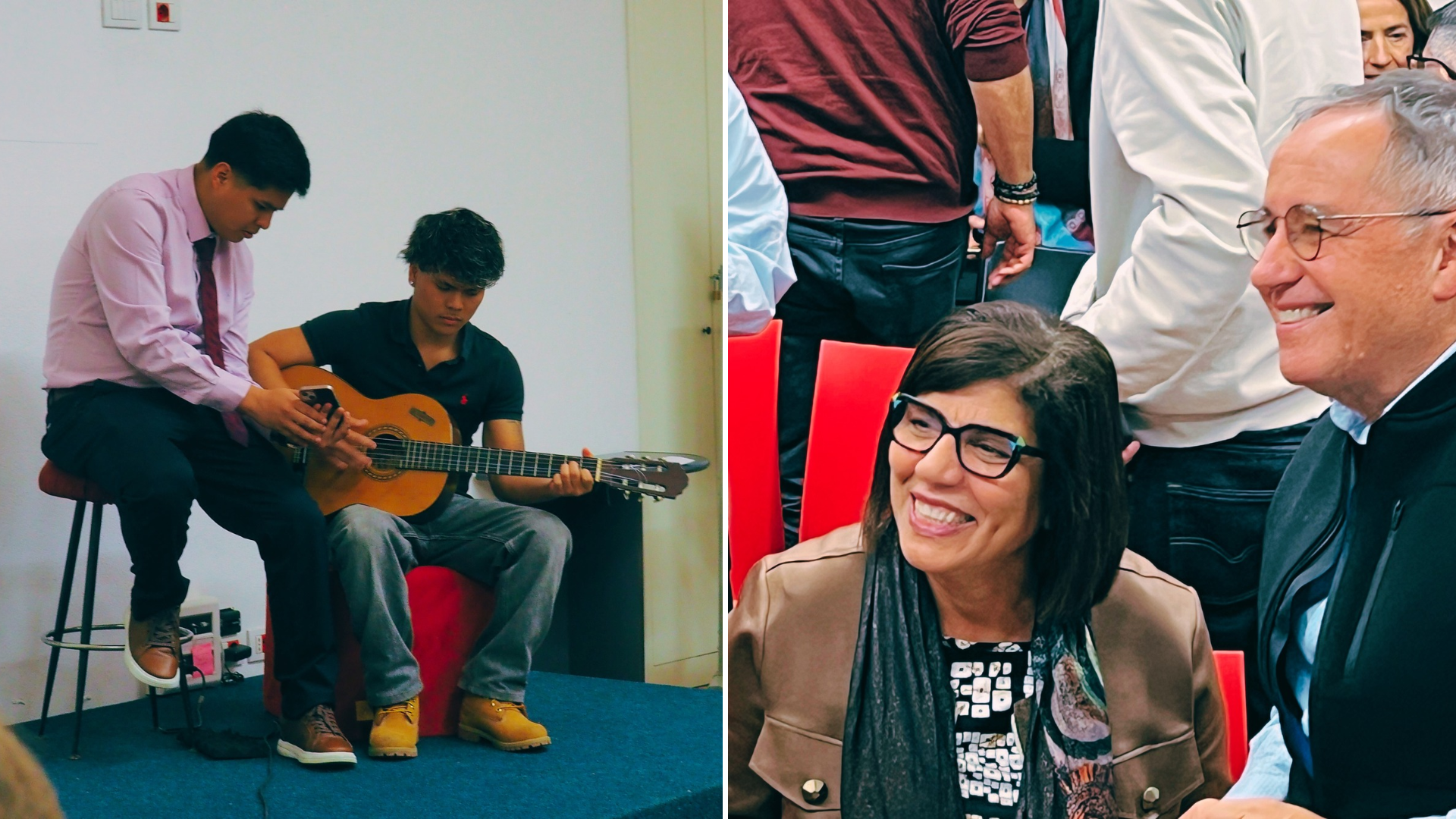
Two hours spent with the young people speaks volumes about Margaret and Roberto’s choices regarding what to prioritise on a Saturday entirely dedicated to the Citadel. And indeed, the first event of the day took place at Casa Nuova, where two young families live – those of Antonio and Luana, and Giovanni and Giulia. For the occasion, there were also other young couples from Loppiano (Roger and Monique, from the Ivory Coast, and Valentino and Emanuela, who arrived three months ago), whilst Marta and Bacchi are due to arrive in a few months’ time. Everything took place in a warm and informal atmosphere, with a desire to get to know one another, and with the six children – ranging from a few months to four years old – at the heart of the visit.
The morning drew to a close at Campogiallo, at the premises of the Formation Centre for the Focolare men and women. It was a precious opportunity for the Movement’s two Leaders to gain a deeper insight into the lives of the Focolarini and Focolarine, following several decades of community life across different parts of the world. In addition to the 12 members of the two teams, there were also around twenty people taking part in the two-month residential ‘Pit Stop’ programme. Margaret and Roberto expressed their deep gratitude for the work of the two Centres and for the impact it is having, and assure them of their full support as they continue on their journey.
Lunch was at the table of the Focolarini in formation. Two come from Colombia, one from Congo, Pakistan and Italy. Another two will arrive shortly, whilst two more are due to arrive in January. Pineapple chicken, roast potatoes and dessert are enjoyed amidst a flurry of questions. Everyone is studying Italian, and the first question is how Margaret managed to learn so many languages. She explains that part of the primary school curriculum in the Holy Land involved learning Arabic, Hebrew, English and French. But her school also included Italian. Little Margaret asked her parents why they were adding this fifth language. And they replied: ‘You’ll see. You’ll need it in the future.’ Prophetic words! Roberto spoke of his non-believing parents, who had not had him baptised. His grandmother, a woman of faith, had accompanied him, but she died when Roberto was six. He immediately asked to be baptised. And so it was.
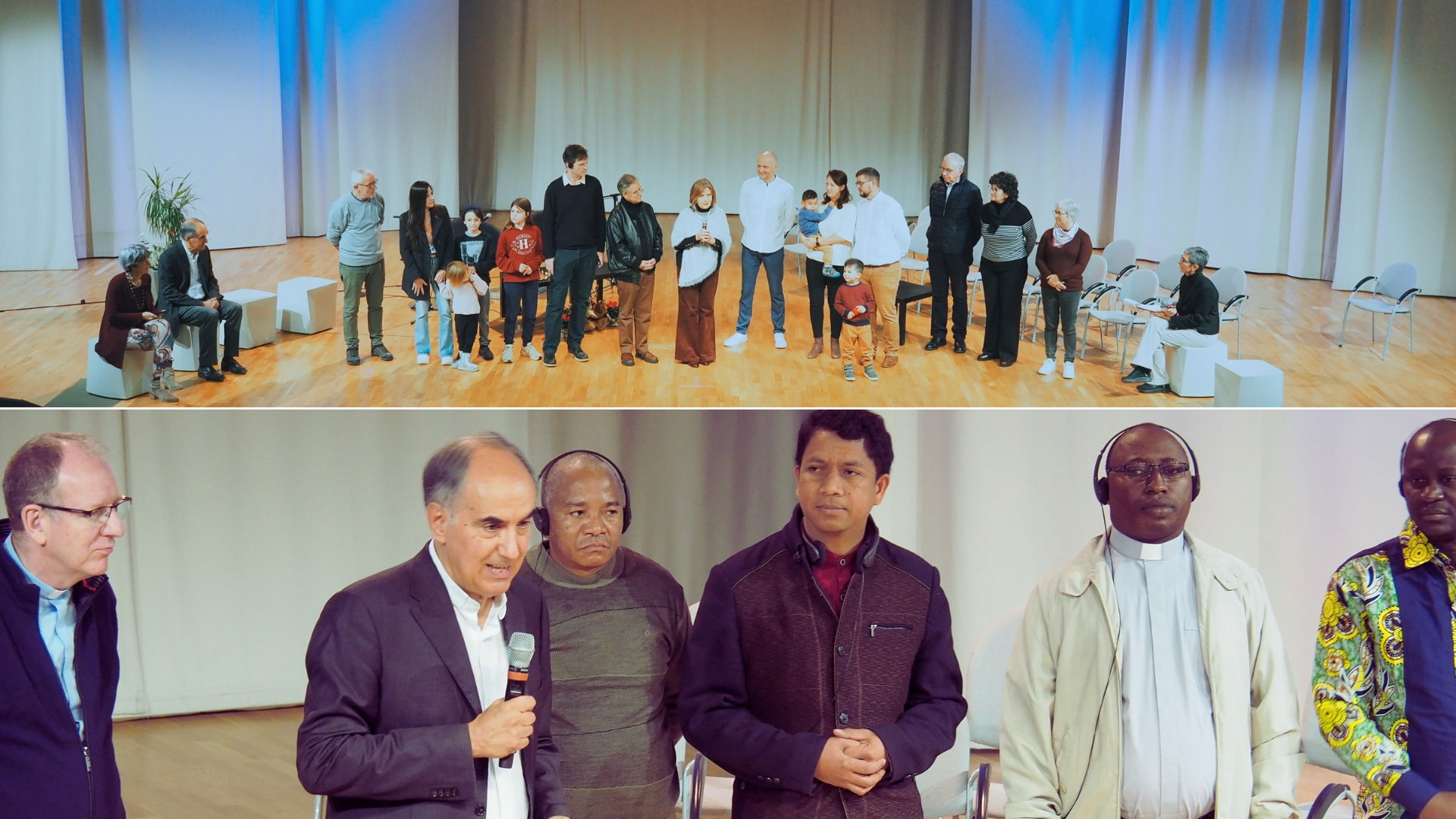
Sunday morning at the Auditorium is the most eagerly awaited moment for the gathering with the residents of the little town. Margaret spares no effort in greetings and hugs. The programme opens with a video showing the demolition of the old warehouses in the industrial area. Traumatic enough, yet also indicative of Loppiano’s journey towards the new reality. And this is evident in the account of Daniele, who came to Loppiano to complete his year of Universal Civic Service without knowing where he had ended up. “I arrived as a stranger,” he explains, “and I left as an adopted son.” Ripe fruits are then borne by the recent and innovative developments at the Loreto School for Families, the priests’ school and the Business Centre, which has just celebrated its first 20 years.
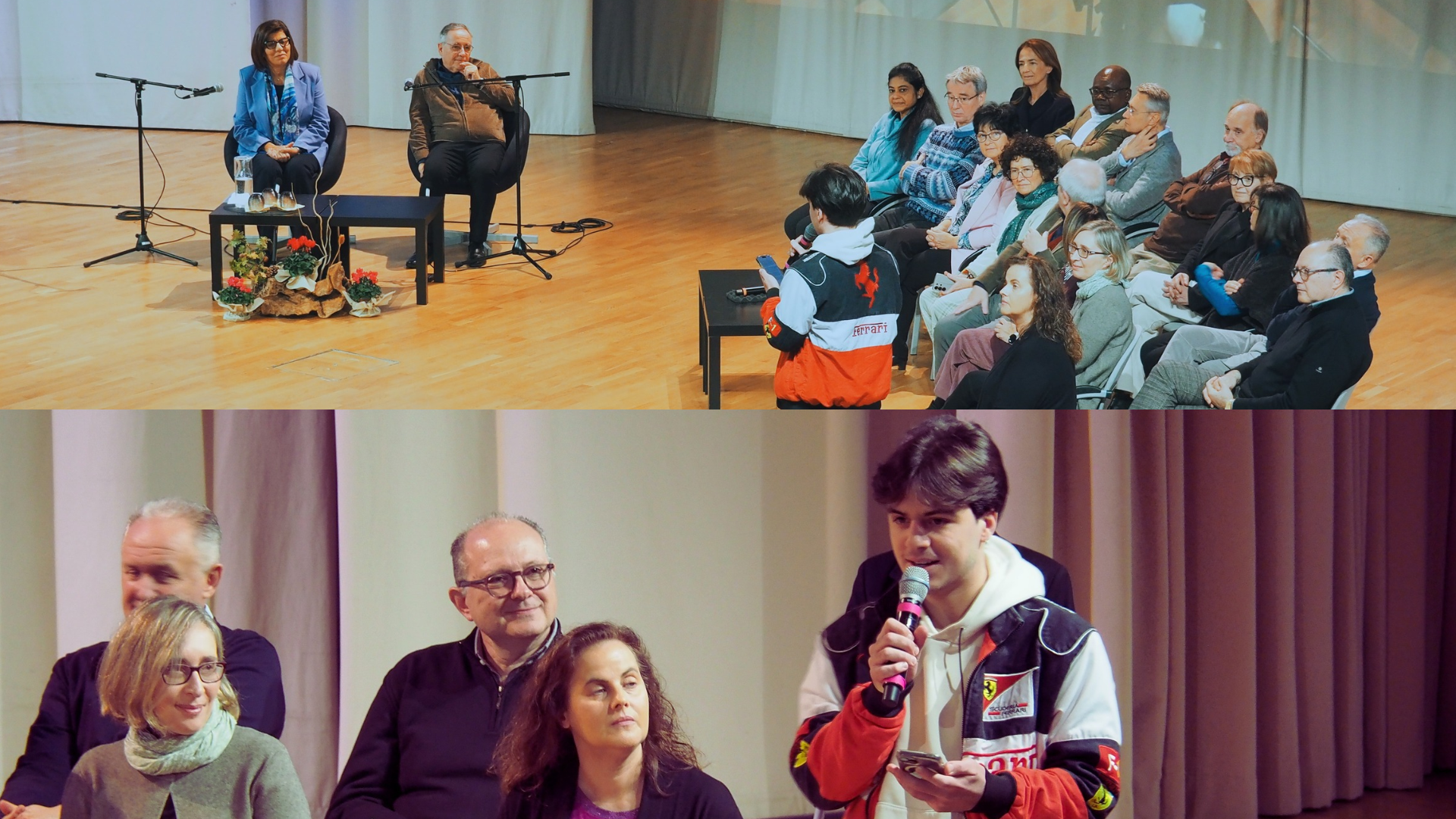
Roberto pointed out that what the Gen 2 group in Loppiano have experienced is a ‘turning point’. “Faced with difficulties, you did not stop; you sought Margaret’s advice, but it was you who decided to take joint responsibility and overcome the obstacles.” He then advised: “Make Margaret’s guidance your own: reach out to the marginalised. Pope Leo, who is a sign of the times, emphasises the Church’s social teaching and, in particular, human dignity. This, in short, is Pope Leo’s moral teaching. And the path Margaret proposes to you is very much in line with this.” Finally, he suggests: “Go and re-read the Pope’s encyclical *Magnifica humanitas*. Look for even just a summary, perhaps generated by artificial intelligence.” But then both of them say to everyone, not just young people: “Better than artificial intelligence, here in Loppiano you have experts; make the most of them. And the Centre is running an excellent course on the Church’s Social Teaching; make the most of it”.