

On Monday 5 October, the Sophia University Institute opened the doors of its Florentine campus in Piazza Tasso to anyone wishing to find out more about its educational programmes. The afternoon event marked the start of the 2026–2027 academic year.
by Alessandro Borghesi
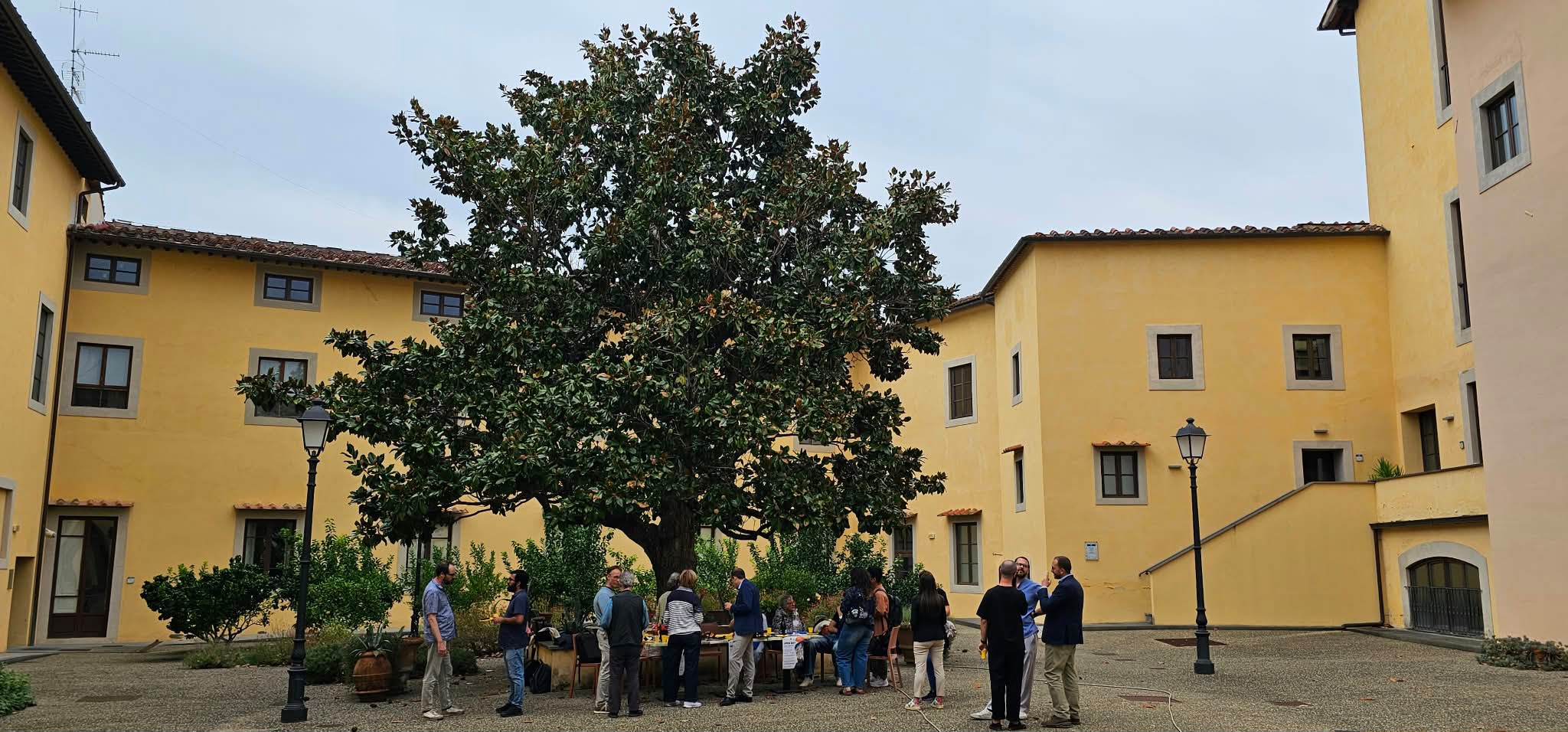
On Monday afternoon, in the courtyard of Piazza Tasso 1/A, in the heart of San Frediano, the large magnolia tree dominating the cosy space between the ochre-coloured façades provided the perfect setting for an event conceived as an open dialogue rather than an institutional presentation. From 4 pm to 6 pm, lecturers, staff and students from Sophia welcomed participants around tables set up outdoors, where questions about study programmes and the dual degree were interwoven with those – no less crucial for those choosing a university – concerning the Institute’s day-to-day life and the nature of the relationship forged there between teachers and students.
Just over a month after the first online open day, which on 28 August had also presented the courses to an international audience, the event in Florence brought to life the tangible essence of an educational offering that makes interpersonal relationships one of its defining features. This was particularly evident in the opportunity for everyone to speak directly with the lecturers of the courses that interested them.
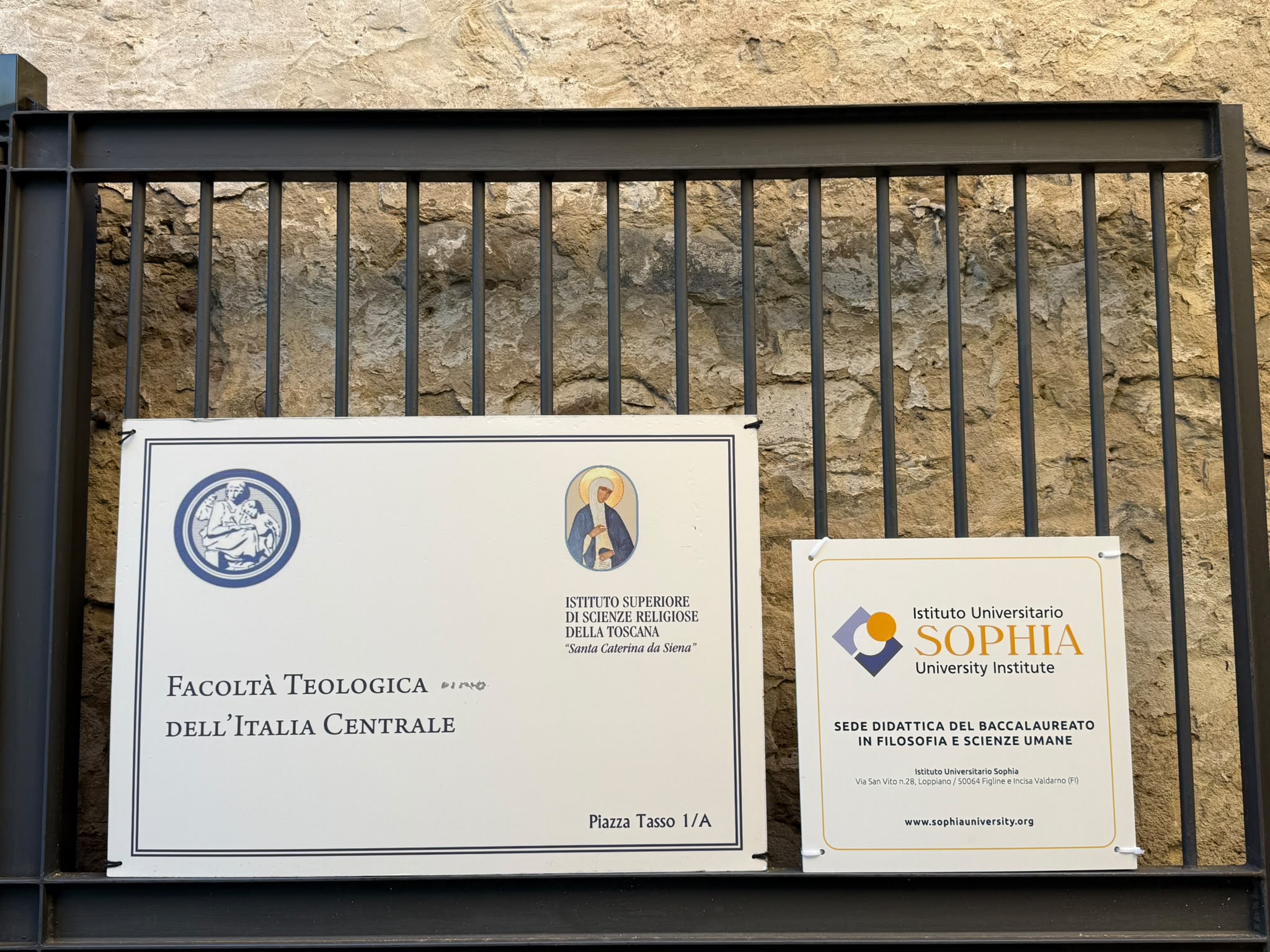
The choice of Florence marks a new chapter in Sophia’s history. From the 2026–2027 academic year, the three-year Bachelor’s degree in Philosophy and Human Sciences will be based in Piazza Tasso, on the premises of the Theological Faculty of Central Italy, whilst the two-year Master’s degree in Philosophy, Economy of Communion and the Environment will remain in Loppiano, at the historic campus on Via San Vito. This gives rise to a 3+2 programme which, for the first time, accompanies students from the start to the end of their university journey and finds one of its deepest reasons in this dual affiliation with both the city and Loppiano: on the one hand, the cultural and academic fabric of Florence; on the other, the experience of community and international life that Loppiano has nurtured for decades.
The most significant development, however, is the dual qualification. Thanks to the collaboration with the Department of Philosophy, Social Sciences, Humanities and Education at the University of Perugia, students on both programmes will be able to obtain, alongside the ecclesiastical qualification awarded by Sophia as an academic institution of the Holy See, a state qualification recognised within the Italian university system. The Bachelor’s degree also comprises two years of integrated study in philosophy, psychology and the humanities, in dialogue with theology, followed in the third year by the choice of a specific specialisation, thus combining a broad perspective with specialised knowledge.
For Sophia, founded on an insight by Chiara Lubich and established by the Holy See in 2007, the coming year is therefore both a culmination and a new beginning. The revamped academic programme, announced last January at the inauguration of the eighteenth academic year, is now entering its operational phase, whilst the characteristics that make the Institute more than just a place of study remain unchanged:
A ratio of approximately one tutor to every five students, which allows for interactive teaching that focuses on the individual, far removed from the logic of overcrowded lecture theatres; an international academic community; and a shared life amongst students, tutors and staff, which finds its fullest expression in Loppiano. Lectures began on 28 September, and the first group of students on the new Bachelor’s programme were also present at the open day.
Applications remain open until 31 October 2026 for non-European applicants, for whom the deadline has been brought forward to allow time for visa processing, and until 18 December 2026 for European Union citizens.
‘Build a different future’ is the slogan chosen for the open day. Behind this phrase lies a conviction that Sophia has nurtured since its inception: that knowledge is not merely a collection of facts, but a tool for understanding and shaping one’s own era, and that it is truly learnt only within a network of relationships. This is perhaps the most tangible promise that the afternoon under the magnolia tree left with those who took part.
For further information: info@sophiauniversity.org · +39 055 905 15 16 (also via WhatsApp) · sophiauniversity.org