


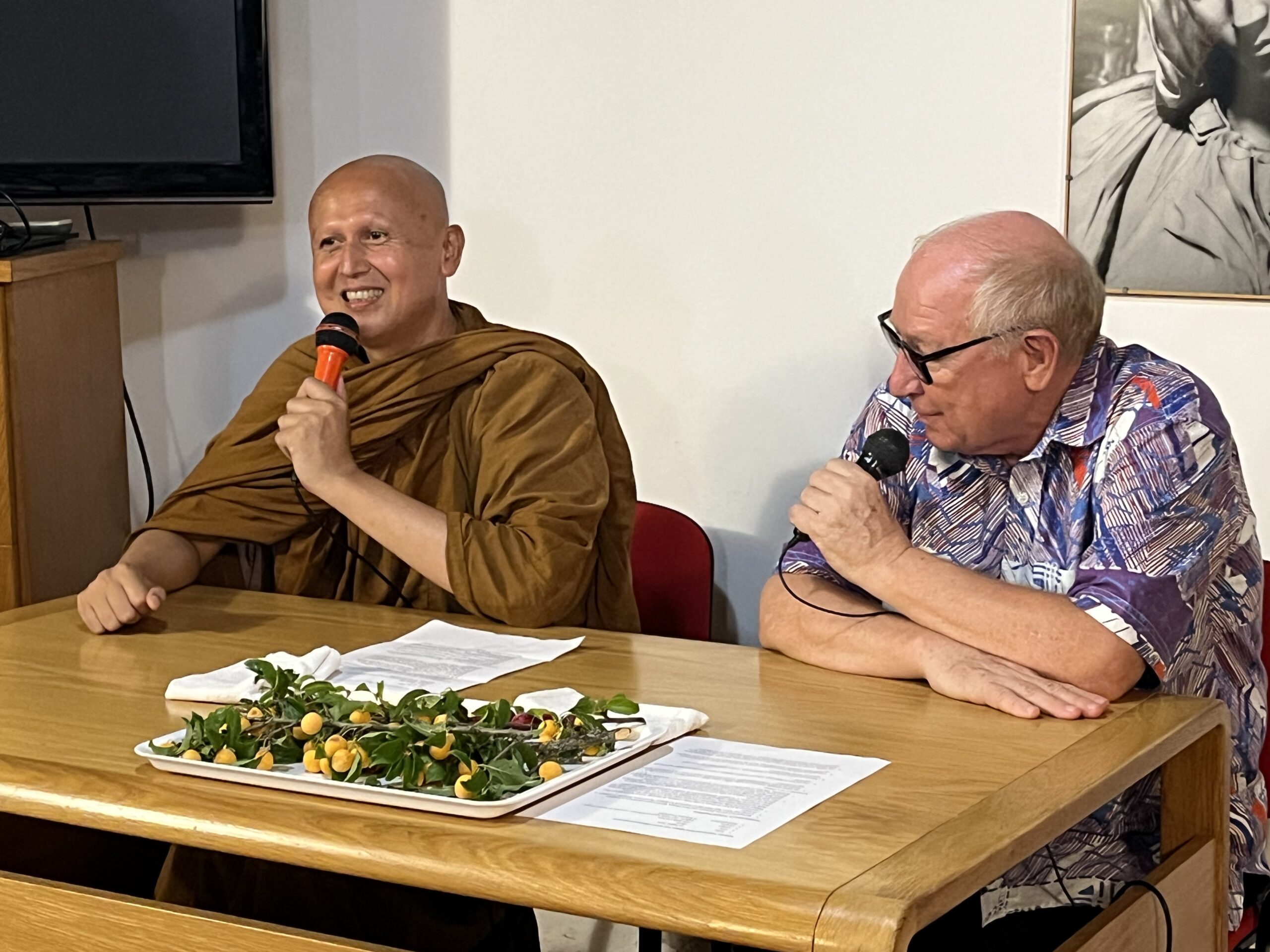
The Thai Buddhist monk returned to Loppiano for two months, immersing himself fully in the life of Loppiano. At the farewell gathering, he spoke about the secret of mindfulness, the centrality of the present moment, and his mission.
by Paolo Lòriga
“You want to live Chiara within yourselves, despite your limitations. I, too, want to be a good Buddhist and I had high expectations of myself.” Phra Pittaya opens up. “It took many years to accept, embrace and, finally, smile at my weaknesses. This is who I am. In this way I learn to love myself, to forgive my weaknesses, and so it is easier to forgive others too.’ The result? ‘I am a happy monk, even if I am not perfect.’
Whenever you meet him, there is always an air of celebration. But on 15 July there were a few more reasons for this. And very good ones at that. A few days earlier, on 3 July, it had been the anniversary (1998) of his ordination as a Buddhist monk, whilst a week later, on 23 July, he was due to leave Loppiano to return to Thailand. So, Fr Antonio Porcellato, head of Claritas (the centre for religious in Loppiano), organised an evening of dialogue with Phra Pittaya at Claritas.
The smiling face of Phra Pittaya, aged 55, is a familiar sight in Loppiano. He had been here two years ago, from mid-March to mid-June, to discover the little town, its openness, and the encounter between cultures and people of different faiths. And he returned this year to live there in full immersion from 25 May to 23 July. ‘There are four fundamental types of dialogue for the Vatican,’ began Fr Porcellato, ‘namely: that of life, that of joint actions for justice and peace, the dialogue of theological exchange and, finally, that of spiritual and religious experience. Tonight’s dialogue is based on life and spiritual experience.’
Phra Pittaya spoke in English: “Meditation in Buddhism is different from Christian meditation, where one reflects on a text.” He went on to explain: “For us, it is about being mindful of everything – of breathing, of walking, and of savouring a walk through Loppiano. When you are mindful of your steps, you are creating new energy. You do not let your mind wander. It is important to be aware of what we are doing in the present’. An example helps: ‘When we eat, we savour the goodness of the dish and feel gratitude for all the elements that make up the food. I eat in silence and must chew slowly as a form of medicine that heals my body. I feel fortunate’.
Breathing. ‘If I turn my attention inwards, I can feel my breath. I am therefore still alive; I can improve; I can enjoy every moment, even if I do the same thing every day. Here at Claritas, my passion is washing the dishes. Simple things can become a miracle.’ At the same time, ‘for me, difficulties are the gift of the present that prepares me for the future. I need to keep fighting, accepting my current abilities and smiling in the face of difficulties, whilst returning to my breath, which reminds me that I am still alive’. A piece of advice: ‘When you’re angry, take a deep breath and hold it for as long as possible. You’ll see the situation more clearly and understand the difficulties, thus preventing your mind from rejecting what’s wrong and what it doesn’t like’.
On 10 November 2025, the Thai Buddhist monk passed away. He was the first to discover the spirituality of unity and met Chiara Lubich on numerous occasions; he was bound to her by such a deep bond that the founder of the Focolare Movement had called him Luce Ardente. Phra Pittaya remembered him with moving words. “Burning Light is here with us now. He never died in my heart. I met him for the first time twenty years ago. He was special, even unique, so different from the others. He had a very kind heart; he had a great love for Chiara, but it was difficult for Thai monks to understand such behaviour.” Phra Pittaya paused, before sharing an intimate recollection. “I met him three months before he died. We had the chance to spend some time together; I confided in him my desire to go to Loppiano for a while. I told him: ‘In Loppiano, they love me as much as they love you.’” Then, he expressed his gratitude to Luce Ardente: “You are the person who showed me the path to follow, and I try to be better so that I may carry on in your footsteps.”
It really seemed as though she was speaking to him, so much so that she then addressed those present with a comment: “When you touch love, you are never alone in your heart.” And she gave her thanks with her broad smile. “I wanted to return to Loppiano because I missed the brothers and sisters there. I wanted to be reunited with people who have a good heart and have dedicated themselves to God. By being with you, I try to touch God.”